"Recycling Food Waste
To Ensure a Sustainable Society."
Local Food Waste Recycling Solutions
From Disposing Food Waste to Recycling it. Helping Achieve SDGs by Reducing Waste Bulk and Waste Cost.
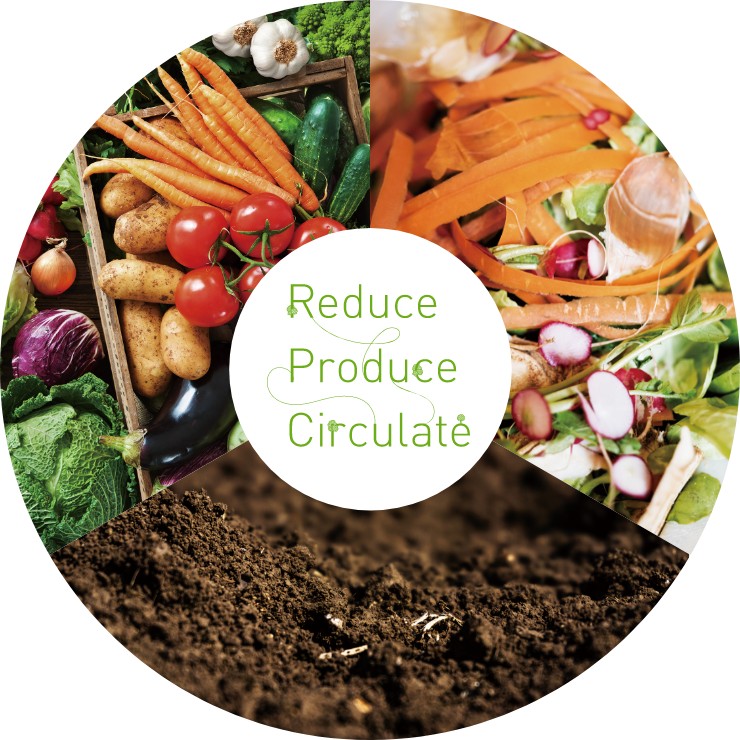
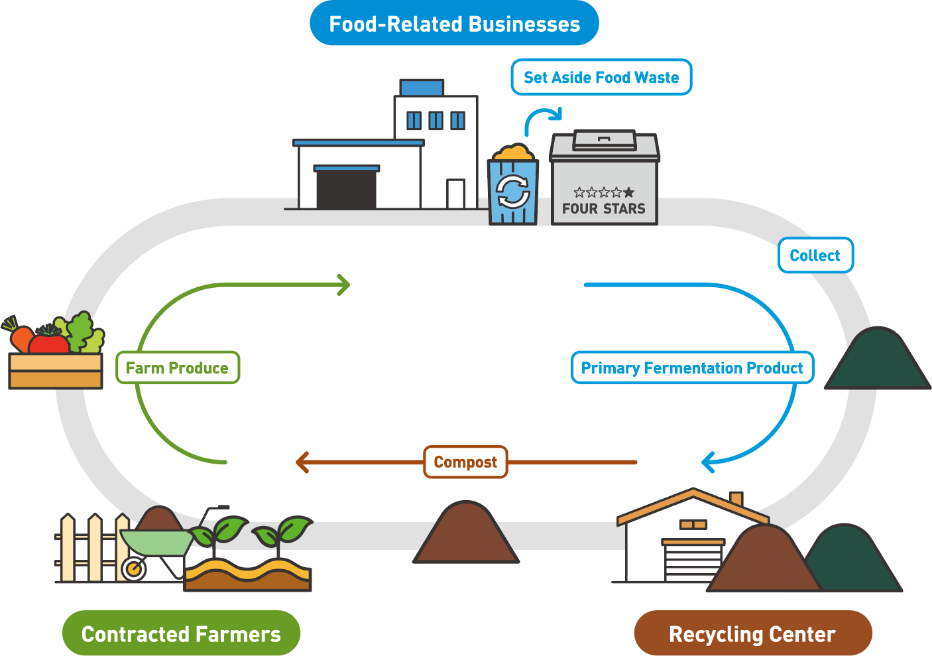
Food becomes waste when disposed of. It becomes a resource when recycled. Local Food Waste Recycling Solutions is an initiative to create a food recycling loop by using food waste as compost to grow new farm produce. Food waste generated by food-related businesses is recycled into a resource at the compost stage, thereby cutting down the amount of waste disposal and at the same time significantly reducing waste cost. This process not only helps reduce food loss, which is a sustainable development goal (SDGs), but revitalizes local economies and helps us achieve a sustainable society.
Solution Overview
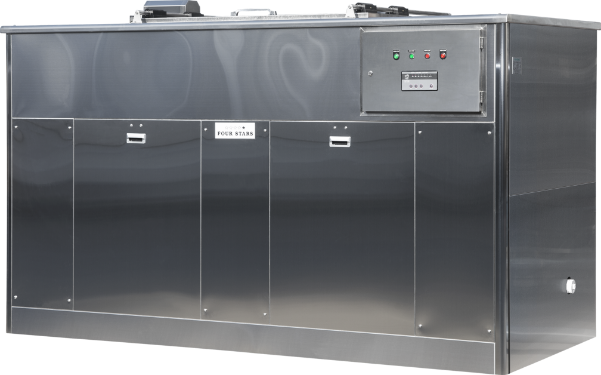
The food waste generated from food-related businesses is fermented and decomposed into a primary fermentation product using Four Stars (a food waste fermentation/decomposition machine). The primary fermentation product is collected and then fermented again at the recycling center, making it into a high quality compost. That compost is supplied to contracted farmers for growing farm produce, which is then circulated, and thereby creating a sustainable society.
Advantages with Our Solution
1Initial Cost 0 Yen
No Initial Investment Required, Monthly Rental of Four Stars (Food Waste Fermentation/Decomposition Machine).
The rental service provides a total package including initial machine introduction and installation as well as maintenance.
2Cut Down Costs Significantly
Recycling Food Waste Reduces Cost Spent on Disposal.
Recycling food waste can significantly reduce the costs that were previously spent to process and dispose large volumes of waste. The case study below shows our solution integrated at a vegetable cutting factory.
3Reduce Amount of Waste
Do Not Dispose of Food Waste, Change it into Compost Material.
Food waste generated in food processing plants and related businesses can be used as compost material and therefore help reduce the amount of waste. If food waste is recycled with Four Stars (food waste fermentation/decomposition machine), the amount of waste requiring processing decreases.
After Integrating Our Solution, the Following is Possible.
Waste Cost Reduced
Support for Achieving SDGs
Help Businesses Manage Decarbonization
Raise Recycling Awareness Among Employees
Recycle Food Waste with Four Stars (Food Waste Fermentation/Decomposition Machine).
Four Stars (food waste fermentation/decomposition machine) is at the heart of our solution. Food waste ferments and decomposes thanks to the power of microbes, creating the compost material or the primary fermentation product in about 24 hours. User operation is very simple, there are no unpleasant odors during fermentation, and CO2 can be significantly reduced when compared with the incineration process. There are 6 different sizes available to match the amount of food waste that is generated.
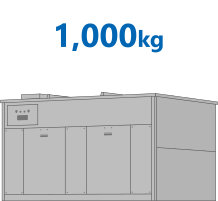
MDT-1000
Ferments/ Decomposes in 24 Hours
Simple User Operation
No Unpleasant Odors
Reduce CO2
6 Different Sizes Available
Machine Lineup
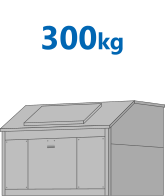
MDT-200 W1,775×D1,010×H1,290mm
MDT-300 W2,125×D1,240×H1,435mm
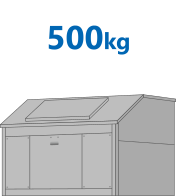
MDT-500 W2,270×D1,300×H1,650mm
175 cm Height
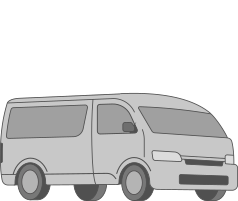
Large Van Approx. 2m Height
MDT-1000 W2,905×D1,350×H1,902mm
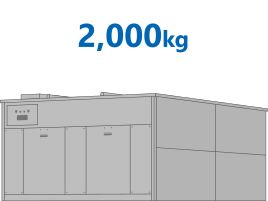
MDT-2000 W2,905×D2,700×H1,902mm
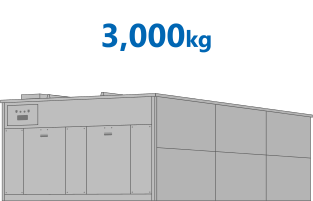
MDT-3000 W2,905×D4,050×H1,902mm
*Quantity shown indicates maximum daily processing capacity.
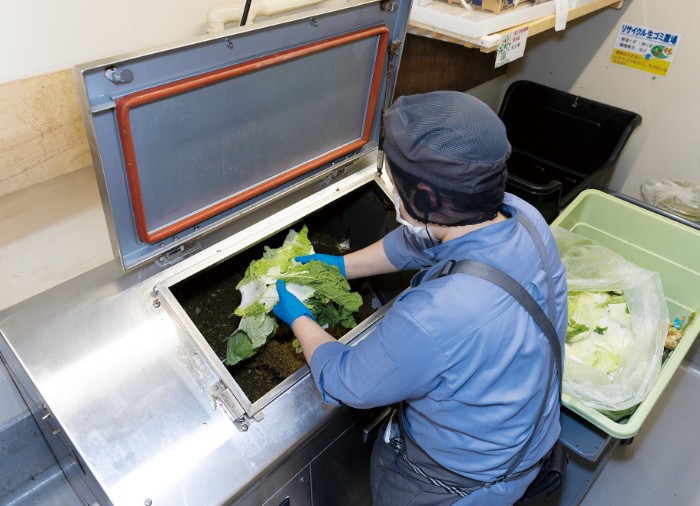
Complicated user operations make using the machine difficult even when the user has access to one. When using Four Stars (food waste fermentation/decomposition machine), user operation is simple. The customer just puts the food waste into the machine to complete the work task, and it can be done easily by anyone.
Customer Work Tasks
Simple and Easy User Operation
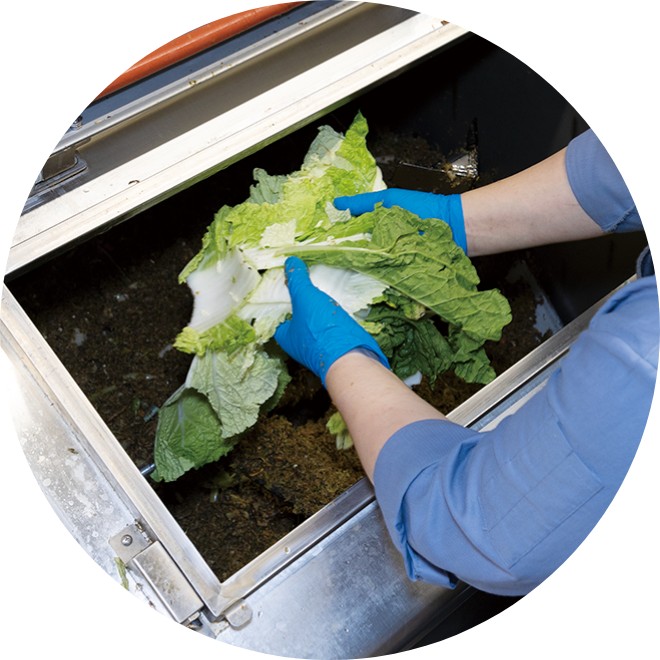
Just put food waste into the machine at the opening on the top to complete the work task.
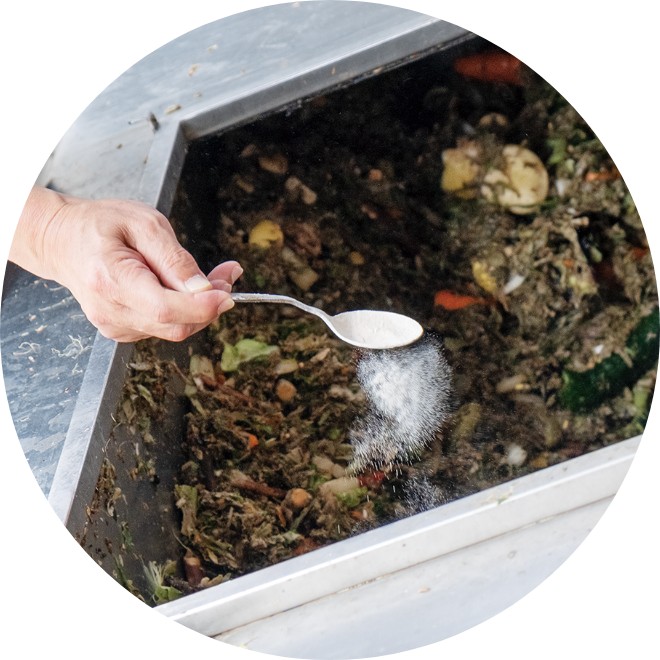
Add Composting Accelerator
Fermentation and decomposition is accelerated thanks to the power of microbes.
Primary Fermentation Product Collected Regularly
Our partners collect the primary fermentation product so there is no burden on the customer.
Cost Simulation is Available
It is easy to do a cost simulation with just 3 pieces of information!
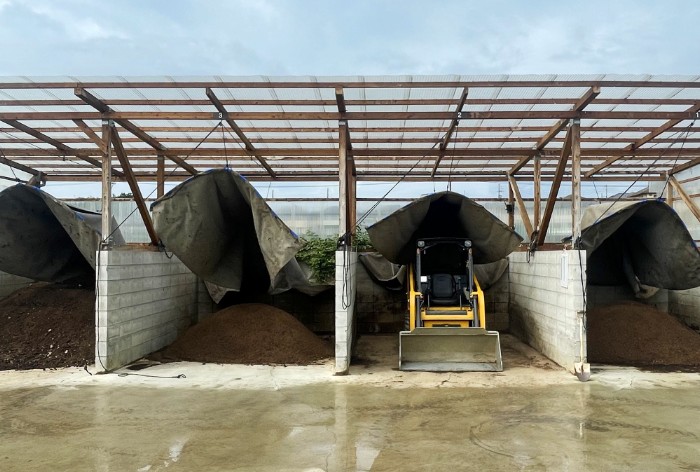
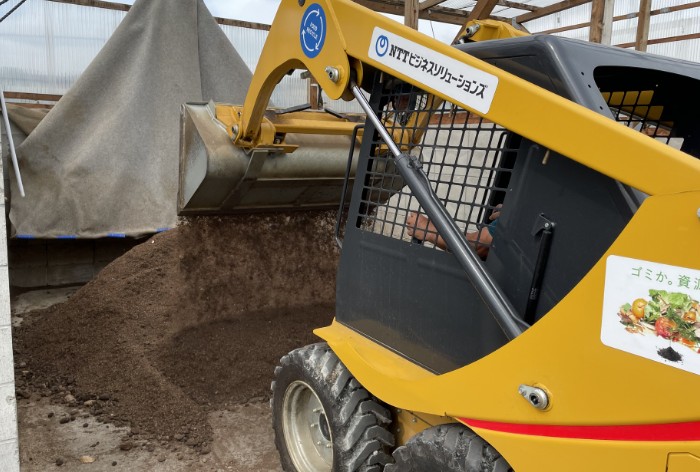
Food waste is recycled to make high quality compost. At the recycling center, moisture and temperature are maintained at optimum levels in order to create high quality compost.
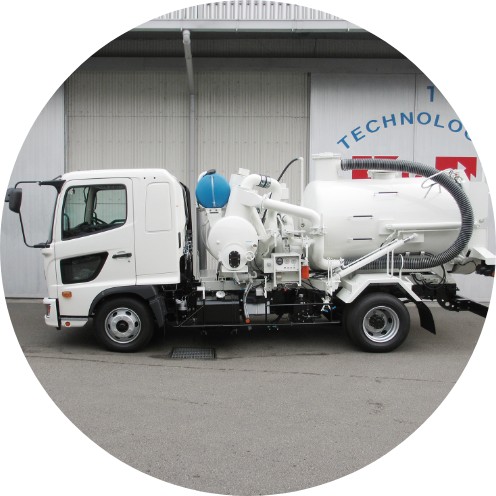
Collect Primary Fermentation Product
Primary fermentation product decomposed by the food waste fermentation/decomposition machine is collected regularly.
Composting in Recycling Center
Our target is to promote maturing with secondary and tertiary fermentation using microbes and turn it into fully mature compost over a span of 3 months to 1 year.
Recycling and Composting Process
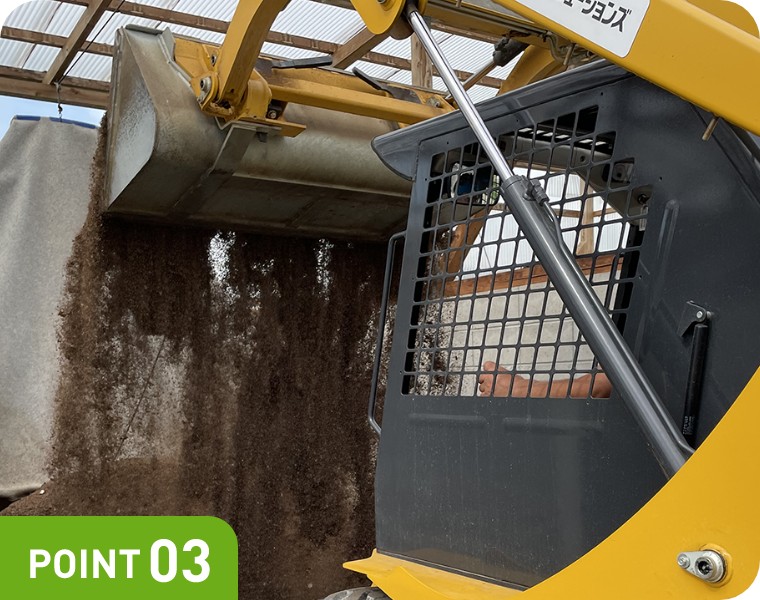
We use our composting expertise and IoT technology to create high quality compost that contracted farmers can rely on. Moisture control, temperature control and other tasks are carried out every day as part of composting at the recycling center. The control levels are carefully managed in the process until the primary fermentation product is matured. The pathogens and seeds remaining in the food waste are heated to a high temperature to kill them and ensure high quality recycling and composting that contracted farmers can rely on.
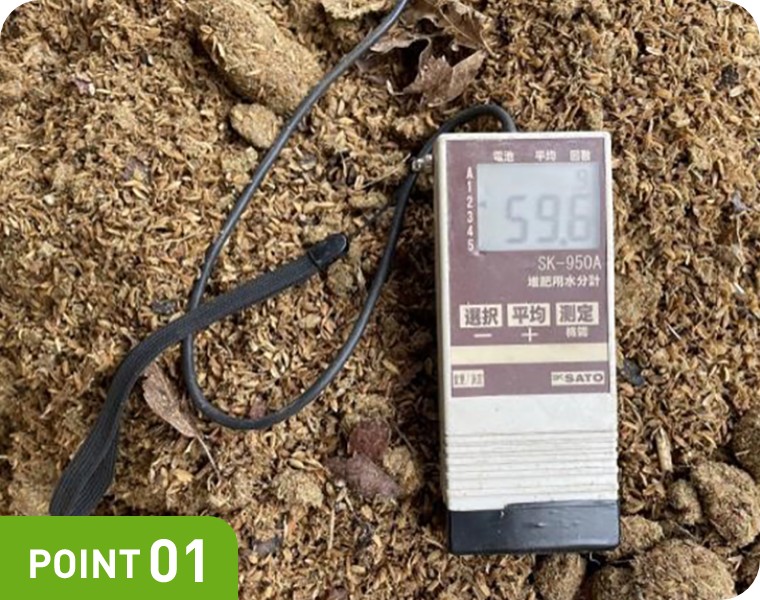
Moisture Control
After the primary fermentation product is brought in and prepared following an established recipe, a moisture meter and/or other instruments are used to keep the moisture at an optimum level around 60%. If the moisture level is too high, a secondary material (such as rice husk) is added to adjust the level.
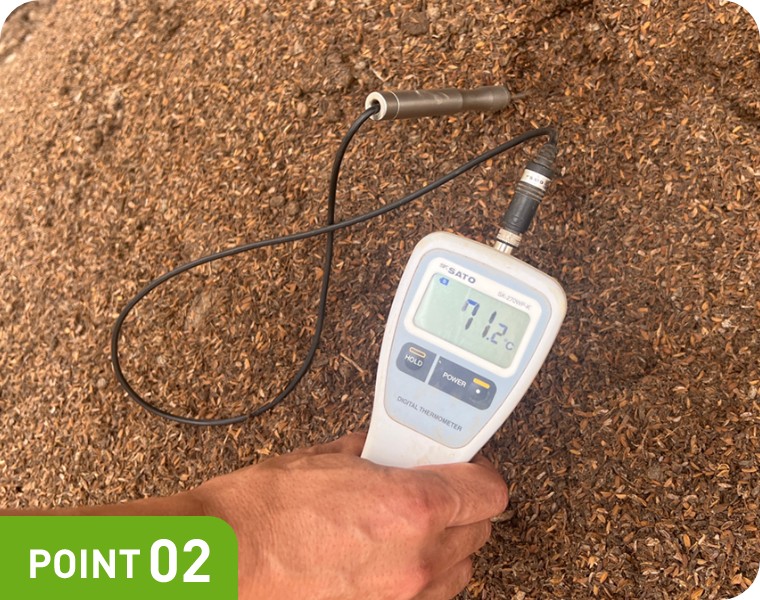
Temperature Control
A special compost thermometer is used to check the fermentation temperature.
Keeping the fermentation temperature between 60° and 70°C for at least a one month period helps the microbes with decomposing.
Cutback
During the fermentation process, cutback work such as deep plowing, moisture control and stirring is carried out.
Performing these work tasks helps create mature, high quality compost.
Recycling Centers Located Throughout Japan
Our Local Food Waste Recycling Solutions provides services for many food-related businesses and continues to expand throughout Japan. Our composting operations are currently running at our recycling centers that are set up all over the country in order to collect and recycle food waste for food-related businesses. Going forward, we have plans to expand our recycling center network further.
Rebuilding Social System for Sustainable Society
I believe that many companies have taken a strong interest in achieving SDGs and carbon neutrality through their businesses.
NTT West has launched Local Food Waste Recycling Solutions to nurture and develop the future of agriculture and food in local communities. The goal of this concept is to help Japan solve issues at the community level caused by food loss, which is at the worst level in the world.
Integrating our solution means not only reducing costs but practicing food recycling in communities in order to create a sustainable society together with all stakeholders including food-related businesses and local farmers. As far as this concept of a loop, we can see the response definitely catching on and growing.
We must rebuild the existing social system to ensure a sustainable society and connect it with the next generation. We welcome and encourage everyone who supports this concept to partner with Local Food Waste Recycling Solutions.
Value Design Department Value Integration Group Director
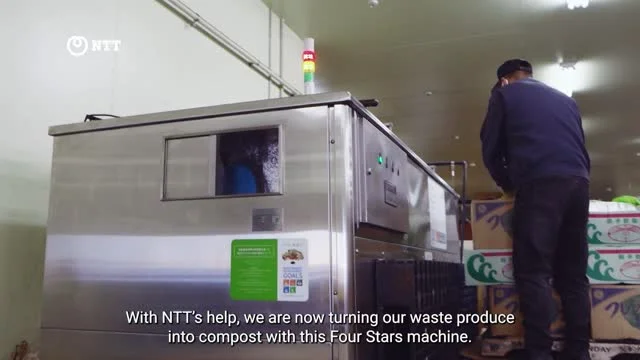
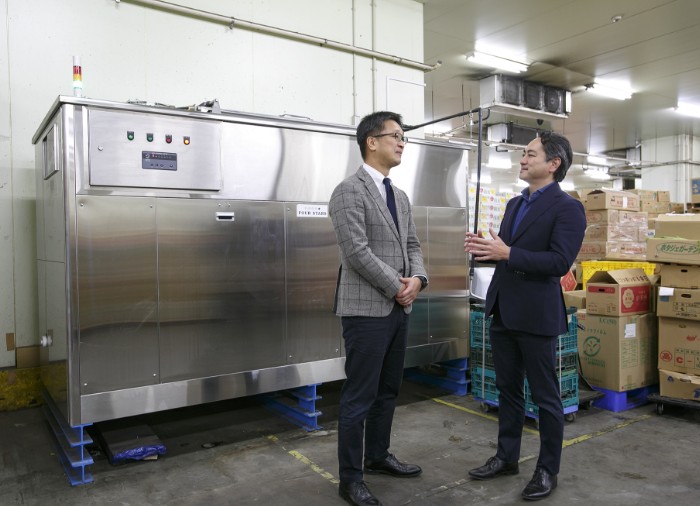
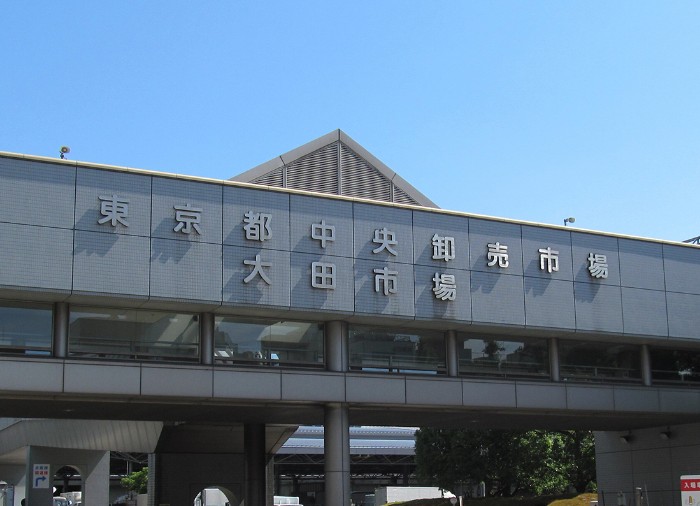
Tokyo Central Wholesale Market Otashijo - Tokyo Sokusei Seika
Use Otashijo Platform to Expand the Loop Nationwide to Cut Food Loss
Before Integrating Machine
Looking to reduce produce thrown out at the receiving and intermediary stages.
Looking for a system to centralize and store waste and make it into a fixed cost.
Advantages After Integrating Machine
After previously using a dehydrator, now the processing cost can be handled as a fixed cost.
Now the work load of the workers can be reduced because each vegetable type does not need to be sorted when putting them into the machine.
Now looking to recycle produce thrown out by retailers and resolve food loss problems on a larger scale.
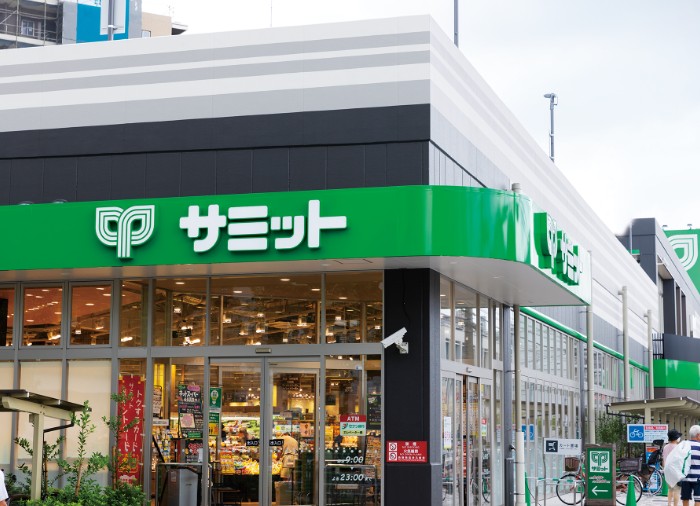
Supermarket - Summit Inc.
Revised Processing Method of Leftover Vegetables in Store, Now Recycling Inside Supermarket
Before Integrating Machine
Approximately 100 kg of leftover vegetables occurred daily when processing products.
A service was used to collect leftovers daily, but the transport related CO2 emissions and transportation cost increased.
Advantages After Integrating Machine
After comparing it with garbage treatment machines (drying and eliminating models), we integrated a compost model (food waste fermentation/decomposition machine) and were able to reduce the impact on the environment.
After installing a machine in the backyard of the store, it helped reduce the amount of food waste.
Part-time workers can also operate the machine easily.
It raised awareness about recycling among employees.
Compost is being sent to local producers and those grown vegetables are also being sold at a store.